











NTW vs HTW Wireline Core Bits: Structural Differences, Drilling Performance and Market Application
NTW and HTW are both internationally standardized thin-wall wireline core drill bits widely used in geological exploration, mineral prospecting, and infrastructure geotechnical investigation. Belonging to the professional TW thin-wall series, both models adopt optimized thin-crown cutting structures to obtain larger core diameters under the same outer drill pipe specification. Despite their identical wireline coring working principle, NTW and HTW differ greatly in physical size, drilling efficiency, formation adaptability, operational stability, and market positioning, making them targeted solutions for distinct drilling depth and construction scenarios.
1. Structural and Dimensional Differences
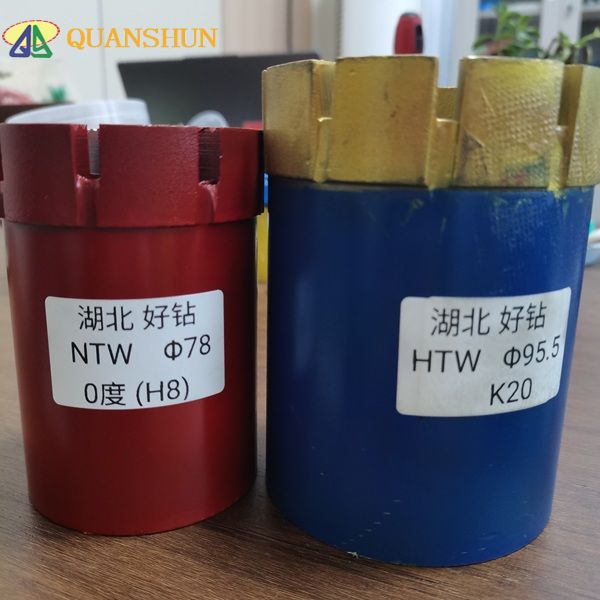
The most fundamental distinction between NTW and HTW lies in overall diameter and core recovery size. NTW is the medium-sized thin-wall core bit, featuring a compact outer diameter and relatively flexible overall structure. HTW is upgraded to a larger-size thin-wall specification with expanded bit crown, bigger water channel layout, and thicker matrix structure.
Compared with NTW, HTW provides a wider core sampling section, delivering larger and more complete rock core samples. Meanwhile, HTW’s enhanced crown structure improves overall rigidity and impact resistance, while NTW maintains a lightweight and portable advantage suitable for small rigs and mobile drilling operations.
2. Drilling Performance and Formation Adaptability
NTW Core Bit
NTW bits excel in shallow to medium-depth coring projects within 300–500 meters. With moderate cutting load and flexible penetration performance, they adapt well to weathered rock, soft and medium-hard mixed formations, interbedded mudstone, and fractured strata.
Its advantages include fast penetration speed, low rig load, and excellent sampling integrity in unstable and broken rock layers. The relatively small water channels match low-to-medium pump flow, effectively preventing mud balling and bit blockage in sticky formations. However, due to its smaller structural strength, NTW is less suitable for deep high-pressure drilling and extremely hard abrasive rock strata, where excessive drilling pressure may cause vibration, bit wandering, or premature wear.
HTW Core Bit
HTW thin-wall bits are designed for medium-to-deep drilling ranging from 500 meters to over 1000 meters. Benefiting from larger waterways and upgraded hydraulic design, HTW achieves stronger slurry circulation and faster cutting removal capacity. It performs outstandingly in dense hard rock, granite, metamorphic rock, and high-abrasion geological layers.
The thicker matrix and optimized diamond layout greatly improve thermal stability and anti-wear performance, effectively resisting bit burning and tooth chipping during long-duration continuous drilling. The only limitation is its higher operational torque and heavier rig load, making it incompatible with small portable drilling equipment.
3. Operational Pros and Cons
Advantages of NTW
- Lightweight structure, low equipment requirements, compatible with most portable and small-scale drilling rigs
- Fast penetration rate and high efficiency for conventional shallow geological survey
- Stable coring quality in fractured and soft-hard alternating formations
- Lower consumption of water and power, reducing on-site construction costs
Disadvantages of NTW
- Insufficient structural rigidity for deep drilling and high-hard rock conditions
- Prone to vibration and diameter loss under heavy drilling pressure
- Shorter service life in high-abrasion hard strata
Advantages of HTW
- High structural strength and excellent impact resistance for deep and heavy-duty drilling
- Superior heat dissipation and chip evacuation, greatly reducing burning risks
- Larger core diameter improves the accuracy of geological resource assessment
- Longer service life and more stable performance in harsh mining strata
Disadvantages of HTW
- Higher torque demand requires larger professional drilling rigs
- Slower penetration speed in soft formations compared with NTW
- Higher manufacturing cost and unit product price
4. Market Demand and Application Scenarios
In the global geological drilling market, NTW and HTW occupy segmented but irreplaceable market shares.
NTW bits maintain strong market demand in rural infrastructure investigation, urban construction geotechnical testing, shallow mineral exploration, and small-scale resource verification projects. Due to their low cost, high flexibility, and wide equipment compatibility, NTW has become the most popular thin-wall coring tool for engineering construction companies and small exploration teams, especially favored in Southeast Asian, African, and domestic civilian engineering markets.
HTW bits dominate professional deep mineral exploration, large-scale mine resource evaluation, geothermal drilling, and national geological survey projects. With the global booming investment in gold, rare earth, and strategic mineral resource exploration, the market demand for high-depth, high-precision coring tools such as HTW continues to grow steadily. Australian, Middle Eastern, and South American mining contractors have long-term stable procurement demand for HTW thin-wall core bits due to their complex strata and deep mining operations.
5. Summary and Selection Guide
In short, NTW is the cost-effective and flexible choice for shallow-medium depth, conventional formation, and engineering-focused coring. HTW is the high-performance professional solution for deep drilling, hard rock, high-precision mineral exploration, and long-cycle mining projects.
Drilling teams and purchasers can select the correct model according to actual drilling depth, rock hardness, rig power, and project budget to maximize coring efficiency and tool service life.
 Global Diamond Tools Market St
 NTW vs HTW Wireline Core Bits:
 Ribbed PDC Core Bits: Strength
 Segmented Diamond Saw Blades: