













Segment Count Selection for Diamond Segments in Stone Cutting — Quantity Logic & Root Cause Analysis
The quantity of diamond segments mounted on a stone saw blade is never random. It balances cutting sharpness, finished edge quality, heat dissipation, chip removal, vibration, service life and overall cutting cost for granite, marble, limestone, sandstone and other natural stone materials.
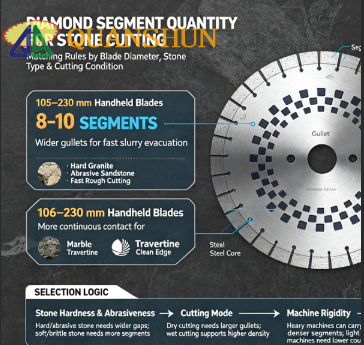
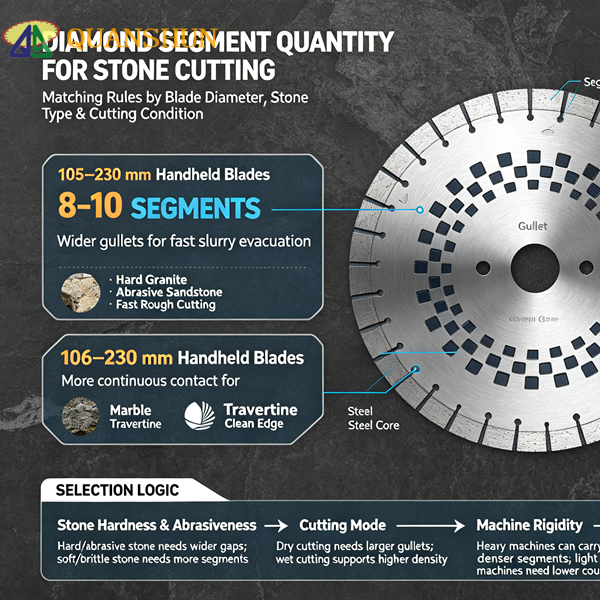
For small handheld blades (105–230 mm), the common segment number ranges from 8 to 16. Fewer segments create wider gullets between each block. These large gaps quickly flush stone powder and cooling water away, making the blade aggressive and fast-cutting. This setup works well for rough cutting of hard granite and highly abrasive sandstone. The trade‑off is heavier vibration and slightly chipped edges. When we increase the segment count to 12–16 on the same diameter, the contact becomes more continuous. Vibration drops obviously, the cutting track turns smoother, and chipping is largely controlled, which suits marble, travertine and finished slab trimming.
On large block saw blades from 900 mm up to 1600 mm, segment quantity usually rises from 64 pieces to over 108 pieces per blade. Large‑diameter blades run at lower peripheral speed and undertake huge feed pressure. More evenly distributed segments share the cutting load, avoid concentrated impact, and reduce the risk of segment cracking or dropping during long continuous cutting. If too few segments are fitted on a big blade, intermittent striking will trigger strong resonance; the blade will swing, the slab thickness becomes uneven, and the wear rate surges sharply.
Three core factors decide the final segment number. First is stone hardness and abrasiveness. Hard, crystalline granite prefers a medium segment count with spacious gullets for dust discharge. Soft marble needs denser segments to guarantee a smooth surface and reduce chatter marks. Highly abrasive sandstone requires wider gaps to prevent mud packing and premature bluntness. Second is cutting mode: wet cutting tolerates relatively more segments, while dry cutting reserves bigger gaps for air cooling. Third is machine rigidity. Heavy fixed block cutters can carry blades with high segment density; lightweight portable machines must limit segment quantity to suppress vibration.
Many customers mistakenly believe “the more segments, the better performance”. In practice, excessive segments narrow the gullets. Stone slurry piles up easily, heat accumulates rapidly, diamonds get polished without self‑sharpening, and the blade turns dull. Too few segments bring faster cutting speed at first, yet repeated impact shortens total lifespan and raises reject rates from edge chipping.
At Fullshun Diamond, we match segment quantity together with segment formula, diamond concentration and bond hardness according to the target stone. A proper segment layout delivers stable feed speed, cleaner cut, longer service life and lower cost per square meter for stone fabricators and quarry operators across the Middle East, Australia and global stone markets.
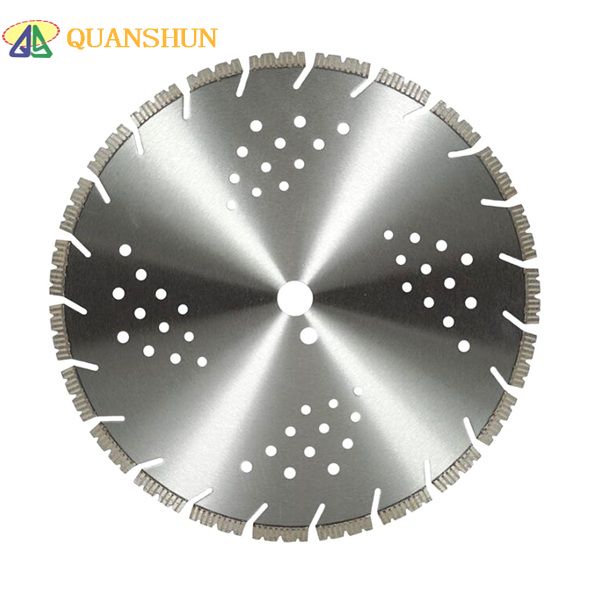 Segmented Diamond Saw Blades:
 Segment Count Selection for Di
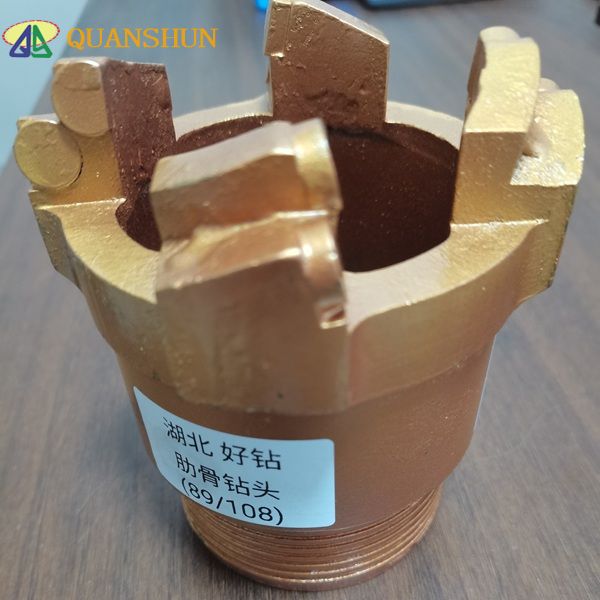
 Polycrystalline Diamond Compac